A large company whose core business is slowing has four ways to find new growth engines: buy, build in-house, partner with startups, or create a new company with entrepreneurs. The available data shows that acquisitions disappoint more often than not and that moves outside the core rarely succeed. Companies that create ventures serially, on the other hand, draw a growing share of their revenue from them. The right choice depends on what the group already owns that nobody else can copy.
Why the question matters now
Leaders have made it a priority. In McKinsey's 2024 global survey (1,176 executives), just over half of CEOs rank building new businesses among their top three priorities. Respondents expect 24% of their revenue to come from new businesses within five years. In 2023, businesses built over the previous five years already accounted for 20% of revenue, up from 12% a year earlier.
What the numbers say about each route
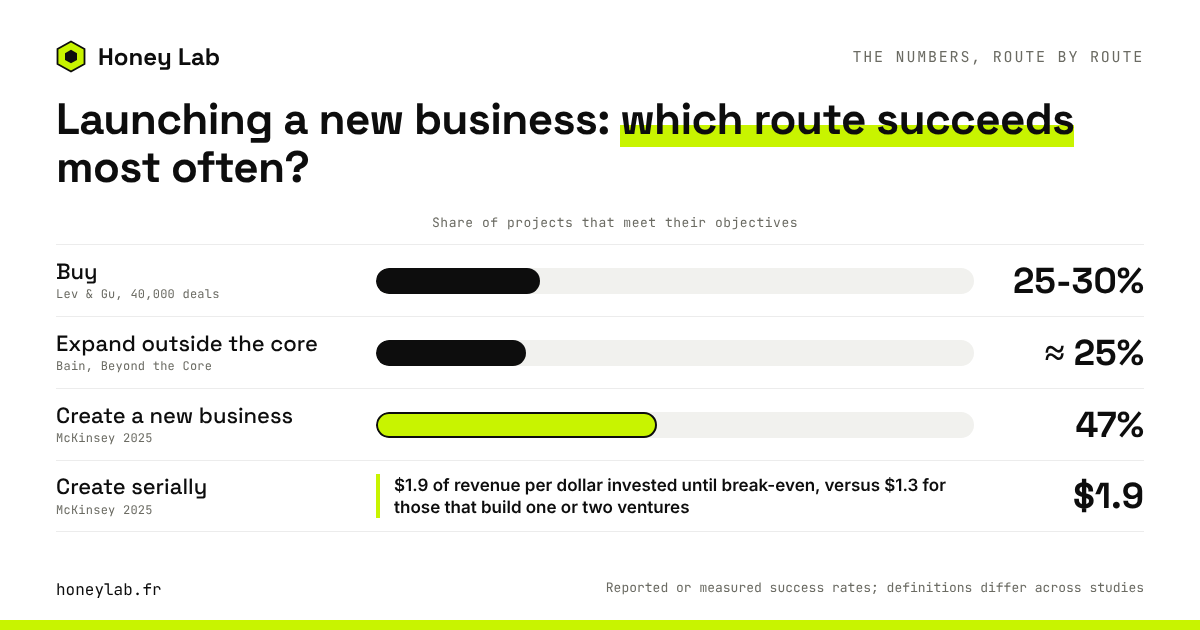
| Route | What studies show | Source |
|---|---|---|
| Buy | 70 to 75% of acquisitions miss their objectives (growth, synergies, share price), across 40,000 deals over 40 years | Lev and Gu, The M&A Failure Trap, 2024 |
| Expand outside the core | about one adjacency move in four succeeds, and the odds fall the further you move from the core | Chris Zook, Bain, Beyond the Core |
| Create new businesses | 47% of new businesses launched in the past five years meet or exceed expectations | McKinsey, 2025 survey (715 executives) |
| Create serially | companies that create three or more ventures in five years earn $1.9 of revenue per dollar invested until break-even, versus $1.3 for those that create one or two; 59% of them get more than 10% of revenue from these new ventures | McKinsey, 2025 survey |
The detail and limits of these figures are on the page what success rates say.
Two examples for each route
Buy
- Daimler and Chrysler (Germany, US). Daimler bought Chrysler for $36bn in 1998. In 2007, it sold 80% of Chrysler to Cerberus for $7.4bn.
- Bayer and Monsanto (Germany, US). A $63bn takeover in 2018. Roundup litigation led Bayer to set aside as much as $16bn; in November 2023, its shares hit their lowest level in more than a decade.
Expand outside the core
- Amazon Web Services (US), the success. Amazon turned the infrastructure behind its website into a service sold to other companies. In Q4 2025, AWS generated $35.6bn in revenue and $12.5bn in operating income.
- Amazon Fire Phone (US), the failure. The same group entered smartphones in 2014 and wrote down $170M the following quarter. Even for a player that strong, distance from the core comes at a price.
Create new businesses
- Nespresso (Switzerland). Created by Nestlé in 1986 as a separate company, with its own distribution model. In 2024, Nespresso posted CHF 6.4bn in sales.
- Exaion (France). Created within EDF Pulse, Exaion moved into high-performance computing and AI infrastructure. In 2025, MARA agreed to take 64% of it for $168M.
Create serially
- Bosch (Germany). In April 2026, Bosch committed about €200M to Bosch Business Innovations, its venture builder, targeting 20 startups in operation by 2030. The group first restructured its previous portfolio: building serially also means knowing when to stop and sell.
- Crédit Agricole (France). According to the Observatoire of corporate venture building, six companies created from zero, mostly out of La Fabrique by CA, a structure whose job is to produce them.
What we see in France
According to the Observatoire, only 13 CAC 40 groups have created at least one company from zero that meets our criteria. Those that succeed have a structure whose job is to produce them: EDF Pulse Incubation, La Fabrique by CA, Kamet at AXA.
Four questions to choose your route
- Is the target market already structured, with a winner you could buy?
- Can the new business live with the group's rules, or would they stifle it?
- Which rare asset do we bring: distribution, data, brand, regulatory standing?
- Are we ready to control a company without running it?
If the answers are "no, no, a rare asset, yes", creating outside with entrepreneurs is probably the fastest route. Further reading: buy, build in-house or create outside and the cost-to-own of a new business.
Sources
- Fortune, Baruch Lev and Feng Gu, 40,000 acquisitions (November 2024)
- Bain, The New Rules for Growing Outside Your Core (HBR)
- McKinsey, CEOs' choice for growth (November 2023)
- McKinsey, How CEOs are turning corporate venture building into outsize growth (October 2024)
- McKinsey, The way to win in corporate venturing: Serial building and AI (October 2025)
- NPR, sale of Chrysler (May 2007)
- Fortune, Bayer at a decade low (November 2023)
- TechCrunch, AWS results (February 2026)
- VentureBeat, Fire Phone write-down (October 2014)
- Comunicaffe, Nestlé and Nespresso 2024 sales
- EDF, MARA and EDF Pulse Ventures agreement on Exaion
- Bosch, press release (April 2026)