No single study compares every route on the same basis. But the major studies converge: about three acquisitions in four miss their objectives, about one move outside the core in four succeeds, and nearly one new business in two launched by a large company meets or exceeds expectations. Returns rise sharply for companies that create ventures serially.
The numbers, route by route
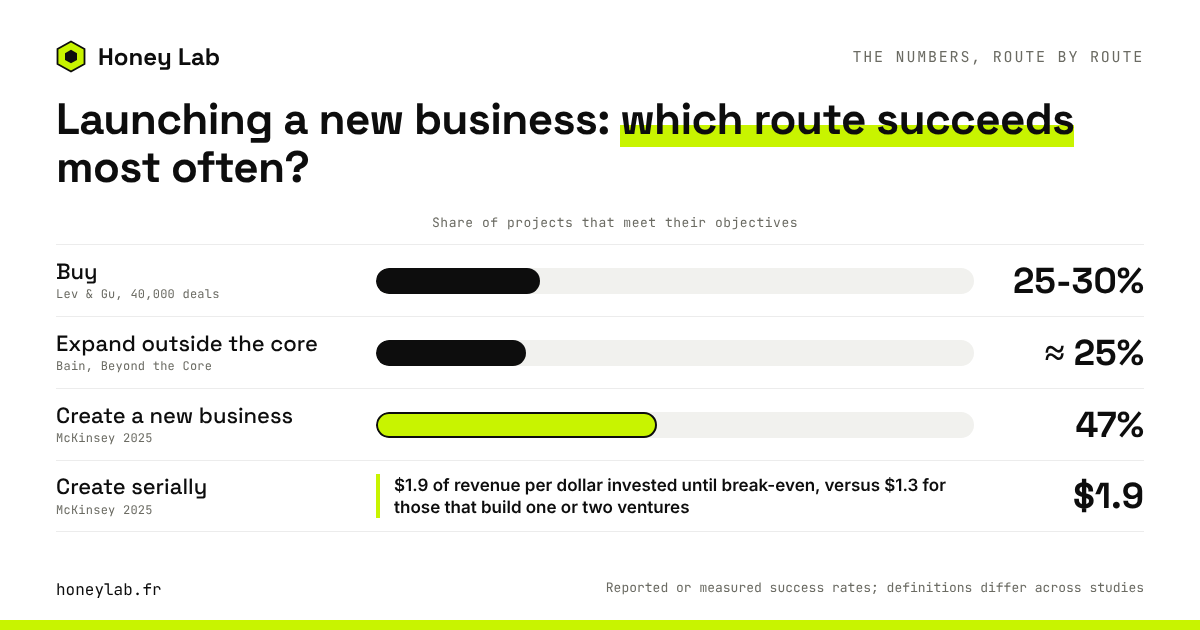
| Route | Observed rate | What is measured | Source |
|---|---|---|---|
| Acquisition | 25 to 30% success (70 to 75% failure) | growth, synergy or share-price objectives met, across 40,000 acquisitions over 40 years | Lev and Gu, 2024 |
| Expansion outside the core | about 25% | successful adjacency moves, sample of about 200 companies | Chris Zook, Bain |
| New businesses built by a group | 47% | new businesses launched in the past five years that meet or exceed expectations | McKinsey 2025, 715 executives |
| Serial builders (3+ ventures in 5 years) | $1.9 of revenue per dollar invested until break-even, versus $1.3 for those that build one or two | revenue per dollar invested | McKinsey 2025 |
Two examples per route
| Route | Example 1 | Example 2 |
|---|---|---|
| Acquisition | Daimler buys Chrysler for $36bn in 1998, sells 80% for $7.4bn in 2007 | Bayer buys Monsanto for $63bn in 2018, sets aside up to $16bn for Roundup litigation |
| Expansion outside the core | Amazon Web Services: $35.6bn revenue in Q4 2025 | Amazon Fire Phone: $170M written down in 2014 |
| New business built by a group | Nespresso (Nestlé, 1986): CHF 6.4bn sales in 2024 | Exaion (EDF Pulse): 64% acquired by MARA for $168M in 2025 |
| Serial building | Bosch: €200M and 20 startups targeted by 2030, after restructuring its previous portfolio | Crédit Agricole: six companies created from zero, mostly via La Fabrique by CA |
Three takeaways
- Buying is fast, not safe. An acquisition brings revenue immediately, but most deals do not deliver on their promises, and Lev and Gu find the failure rate has not fallen over time.
- Moving away from the core is risky. The odds fall the further you move from existing customers and skills. That is precisely where a different team and structure are needed.
- Creating works better when done serially. Companies that build several ventures learn, pool resources and decide faster. A one-off venture looks more like a bet.
What we have seen
Since 2019, six companies co-founded with large groups, about €46M raised, about 82% of invested capital still at work. It is not a statistical sample, it is our experience.
Limits of these figures
Definitions of success differ from one study to another (stated objectives, expectations, revenue), and McKinsey's surveys rely on executives' own reports. These figures compare orders of magnitude; they do not predict the outcome of a project. To choose your route, see new growth engines: how a large company launches new businesses.
Sources
- Fortune, Baruch Lev and Feng Gu, 40,000 acquisitions (November 2024)
- Bain, The New Rules for Growing Outside Your Core (HBR)
- McKinsey, CEOs' choice for growth (November 2023)
- McKinsey, How CEOs are turning corporate venture building into outsize growth (October 2024)
- McKinsey, The way to win in corporate venturing: Serial building and AI (October 2025)
- NPR, sale of Chrysler (May 2007)
- Fortune, Bayer at a decade low (November 2023)
- TechCrunch, AWS results (February 2026)
- VentureBeat, Fire Phone write-down (October 2014)
- Comunicaffe, Nestlé and Nespresso 2024 sales
- EDF, MARA and EDF Pulse Ventures agreement on Exaion
- Bosch, press release (April 2026)